
Why Your Local Business Isn’t Ranking on Google (And How to Fix It)
If you are ignoring local SEO, you are effectively handing your neighbours and potential customers directly to your competitors.
It’s a frustrating scenario familiar to many business owners across the Hunter Region. You have a sleek website, you offer a superior service, and you’ve been serving the Newcastle community for years. Yet, when you search for your service on your smartphone, your business is nowhere to be found. Instead, a newer competitor with a mediocre website is sitting at the top of the search results.
Why is this happening?
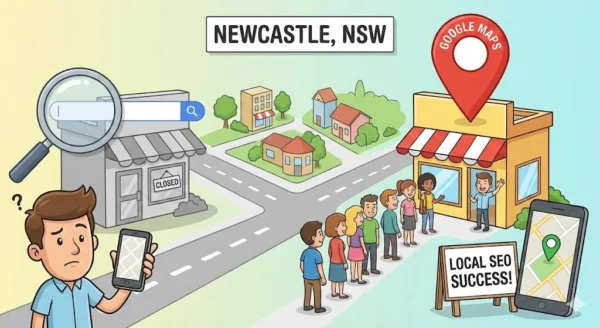
The answer usually lies in a misunderstanding of how Google determines “local” relevance. Ranking a website for a general term is a completely different ballgame than ranking for a geographically specific query.
Here is why your digital visibility might be suffering in the local market and the practical steps you can take to fix it.
The “Near Me” Reality Check
The first thing to understand is that Google has evolved. It is no longer just a search engine – it is an answer engine.
When a user in Hamilton pulls out their phone and searches for a “café” or “electrician,” Google doesn’t just look for the best website in the world. It looks for the best solution closest to them. This is the core of the algorithm update that shifted the marketing landscape: user intent.
If your site is optimised for generic terms but lacks strong local signals, Google has no way of knowing that you are the best option for someone standing on Darby Street.
This is where the distinction between traditional SEO and local search becomes critical. Traditional SEO focuses on your website’s global authority. Local search focuses on your relevance to a specific location. You might have the best content in the industry, but if Google can’t confidently verify your physical presence in Newcastle, you won’t make the cut for the “Local Pack” (block of map listings that appears at the top of the search results).
The Power of the Google Business Profile
If your website is your digital headquarters, your Google Business Profile (formerly Google My Business) is your digital shopfront window. It is the single most influential factor in your google maps ranking.
Many business owners claim their profile, fill in the basics, and never look at it again. This is a fatal error. Google treats this profile as a living, breathing entity. An inactive profile signals a potentially inactive business.
To signal authority, your profile needs to be comprehensive. This means selecting the correct primary business category. This is a critical ranking factor and utilizing secondary categories to capture niche traffic. It means uploading high-quality photos of your team, your office, or your completed projects in the Hunter area.
Furthermore, Google allows you to post updates, offers, and events directly to your profile. Utilising this feature signals to the algorithm that you are active and engaged.
Expert Insight: Google explicitly states that relevance, distance, and prominence are the three pillars of local ranking. You can’t control distance (where the user is), but you can control relevance and prominence through a fully optimised profile.Learn how to improve your local ranking on Google.
The “NAP” Trap: Consistency is Key for Local SEO
In the world of search algorithms, confusion equals distrust. If Google encounters conflicting information about your business, it loses confidence in your validity and can hurt you local SEO pressance.
This brings us to the concept of NAP: Name, Address, and Phone number.
It sounds incredibly simple, but data discrepancies are a leading cause of poor rankings. Perhaps your Facebook page lists your address as “Suite 1, 100 Hunter St,” your website says “1/100 Hunter Street,” and an old Yellow Pages listing has a previous phone number.
To a human, these look like minor variations. To a bot crawling the web, they look like three different businesses.
For an Australian business, you need to ensure your NAP data is identical across specifically relevant directories. We aren’t just talking about global platforms, we mean local citations like True Local, Hotfrog, and even your local chamber of commerce. Consistency across these platforms validates your existence and solidifies your location in Google’s index.
Localising Your Website Content for Local SEO
A common mistake we see at Pixel Me This is businesses treating their website as a generic brochure. They write copy that could apply to a business in London, New York, or Sydney.
To rank in Newcastle, your website needs to speak “Novocastrian” to the search engines.
This goes beyond just slapping “Newcastle” in your footer. It requires building a narrative of local involvement.
- Create Location Pages: If you service distinct areas like Merewether, intricate suburbs like Lambton, or wider areas like Lake Macquarie, consider creating specific landing pages for those locations.
- Local Content: Write blog posts about local projects or case studies. If you are a builder who just renovated a heritage home in Cooks Hill, write about it. Mention the suburb. Mention the specific challenges of the area.
- Embed a Map: On your contact page, embed a Google Map pointing to your office.
By weaving local context into the fabric of your site, you help Google “triangulate” your service area, making you a more relevant result for searchers in those zones.
The Currency of Trust: Reviews and Reputation
You cannot buy your way to the top of the local SEO search results; you have to earn it. Reviews are the currency of that trust.
Statistics show that nearly 98% of consumers read online reviews for local businesses. Google knows this. Consequently, review quantity, review velocity (how often you get them), and review diversity are massive ranking factors.
However, simply getting a five-star rating isn’t the end of the story. You need to respond.
Responding to reviews – both positive and negative, shows that you value customer feedback. It also provides a subtle opportunity to reinforce your keywords. A response like, “Thanks for choosing us for your plumbing emergency in Adamstown,” reinforces your service and your location naturally.
Why You Can’t “Set and Forget”
The digital landscape in Newcastle is becoming increasingly competitive. As more local businesses wake up to the potential of digital marketing, the bar for entry gets higher.
Google updates its algorithm thousands of times a year. What worked in 2023 might be obsolete today. The businesses that dominate the rankings are the ones that treat SEO as an ongoing operational habit, not a one-off technical fix.
These businesses are constantly gathering new reviews. They are updating their Google Business Profile with new photos. They are publishing content that helps their local community solve problems.
Taking the Next Step
If your phone isn’t ringing and your foot traffic is low, it’s rarely because there isn’t a market for what you do. It is because that market cannot see you through the noise.
Fixing your local SEO visibility requires a systematic approach. It starts with claiming your territory on Google Maps, ensuring your data is spotless across the web, and creating content that resonates with the Hunter region.
However, navigating the technical nuances of schemas, citations, and algorithm updates can be time-consuming for a business owner focused on day-to-day operations.
If you are ready to stop hiding from your customers and start dominating the local search results, we can help. Our team at Pixel Me This specialises in high-impact local SEO services tailored specifically for Newcastle businesses.
Let’s get you on the map.